Thursday, July 29, 2010

Wednesday, March 10, 2010
Thursday, March 4, 2010
Monday, February 22, 2010
HOW TO SOLVE A WORD PROBLEM
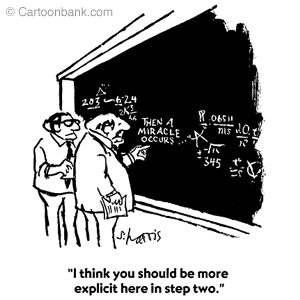
Step 1. Ask: What do I know? Quantify what is quantifiable.
Step 2. Ask: What is the question asking? Determine what you are trying to solve.
Step 3. Pick your calculation. Your calculation may not be your solution but may give you what you need to get your solution. Step 1 will always give you what you need for Step 3.
Step 4: Make your calculation and determine your answer(s).
Step 5: Check your answer. Make sure you made any necessary conversions. Go back to step one and notice if your data were in the same format. Plug your answer into your calculation to check and see if your calculations were accurate.
Thursday, February 18, 2010
Wednesday, February 10, 2010
3 Ways to Improve Your Academic Performance
Everyone is running out of time. It seems, or at least it feels, that 24 hours in a day was something our grandparents had. Now all we get is 22. Here are 3 ways to make quick improvement in your academic performance:
1. Eat Protein for Breakfast. It's brain fuel, curbs hunger and stabilizes blood sugar. http://www.medicinenet.com/script/main/art.asp?articlekey=50736
2. Download after school. That doesn't mean adding songs to your play-list. After a day of learning, simply reviewing what was covered that day can increase retention significantly. Do it!
3. Always take notes. Students turn this on and off. Don't. Always be taking notes. This gets you into a state of active learning. Watch what a professional tennis player does when they are waiting for a serve. They are on their toes...moving. This motion gets them into a rhythm which allows for the game to actually slow down. This Matrix like state is crucial for learning as well. Being an active note taker increases comprehension, improves awareness, and has an effect of slowing down the information channel thereby making learning easier.
Saturday, January 9, 2010
Getting over math
As an opening entry for this blog, it seems à propos to tackle one of the more dicey topics. I find that most students who do not like math at one point in time did, in fact, like math at another. Something happened and what was once a fun and easy exercise in logic and the gamesmanship of logic turns into this very abstract art for only the elite. Students give up. They "throw in the chips". Sadly, before the game ever starts. I often observe that a student will exhale as if to let out a fateful "oh no" when I begin to do a math problem on the white board. It is the medicine with a very bad taste.
Then I tell them something that gets them frustrated at first, contemplating secondly, and finally opens them up to vistas that they did not know were possible. Yes, math as we know it was developed by a group of ascetic philosophers and continued to develop under the guidance of great thinkers. A life of contemplation, even religious like zealousness, may be conducive for mathematical genius. However, this misses the task completely.
What is the secret (well actually it is no secret!) that can unlock the closed mind to math? I remind the student that there is nothing in mathematics, excluding of course the very abstract notions taken in advanced university courses, that is not common to the every day exercise of the mind. In other words, we think math without trying.
Our minds are masterful calculators that enable us to do incredible amounts of geometric and algebraic calculations every minute. These tacit or inherent skills unfortunately get divorced in the young student's minds from their approach to mathematical calculations and in turn a disconnect begins to grow between the student's attitudes about math and the student's attitudes about the "real world." This distance in someway is proportionate to the students ability to do math and the type of attitude they have about it. To say it another way, a student who does not see math as relevant or as a part of "the real" cannot feel comfortable doing it. It is "not real" for them and ultimately unnatural (hence the loaded aspirations)
To blaze a path is one thing, to follow a path is another. Yes, mathematics does come to us through the work of genius minds but in most cases their time and efforts can become the place holders of our thoughts not the inaccessible state of enlightenment for the chosen few. Like those who follow a path, it is merely a matter of naturally placing one foot in front of another, not the difficult and painstaking task of those who blazed the trail. However, if you approach the path with fear as if there is no path, you likely will never begin the journey.
Subscribe to:
Posts (Atom)